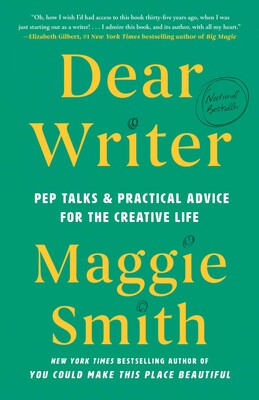
The cover detail that drew me to Maggie Smith’s craft volume (subtitled Pep Talks & Practical Advice for the Creative Life) is the ballpoint-penned dotting over the i’s, that had me seriously testing their veracity.
I read the pieces over a couple of months—each about five pages long, sometimes with recommended reading at the end—and regularly ran my fingertips over those spirals, alternately convinced that a clerk at the shop had added them, or that a detail-obsessed designer was just that detail-obsessed.
Which fit with my initial reason for ordering her book: an article in “Poets & Writers” which underscored the importance of attention, an element immediately recognisable in this collection.
That should also have alerted me to the fact that, above all, Maggie Smith is a poet (Poets & Writers). To my pleasure, this translates into an inordinate number of reading recommendations from small presses and writers’ writers (or poets’ poets)—both diverse and current.
To my disappointment: no, there’s no disappointment, because Smith’s advice is every bit as relevant to prose writers as poets. Even her reading recommendations include novels! (There is, actually, one segment in which I could not adapt the advice to suit a prose writer, but it didn’t annoy me—it only made me wish I was a poet.)
It seems that anyone who’s found inspiration in other art forms (say, film or photography) could embrace the underlying points she makes. “You can’t force a poem, but I think you can prepare for one” becomes, for instance, “You can’t force a short story…” or “You can’t force an essay…”.
Her advice is both succinct and specific: I appreciate that she includes a piece on Word Choice, for instance. “What words would they naturally use? Creek or crick? Soda or pop? Would they fix dinner, cook dinner, or make dinner? Would they mow the lawn or cut the grass?” It’s not common that prose writers are reminded that every word matters—particularly when much of publishing is digital and increased wordcounts don’t increase publishers’ costs—but, it’s true.
It turns out that I enjoy Maggie Smith’s poems, too. Although I would have preferred more examples drawn from the work of other poets (I understand—copyright complications, ensuing expenses). But at this point in her career, I suspect I’m in the minority, discovering her poetry because I’ve read an essay on her craft; most people reading this book are likely discovering her craft writing because they’ve read her poems. In that case, the insight to her writing process and comments on how certain poems came to be would likely be of equal interest. (Anyway, it’s not the place to find poetry recommendations, really.)
On occasion, there’s some repetition, which suggests that these pieces have been designed with workshops—and other situations in which readers are making random and selective choices—in mind. But it wasn’t annoying, largely because the very elements repeated are the core elements that drew me to Smith in the first place. For instance, her reasons for reading and for writing:
“I don’t go to literature for comfort. As a writer or as a reader – I read and write to be changed, to see anew, to revise my own thinking. Actually, change is the opposite of comfort. But change invigorates. It stretches muscles you might not have known you had. It might hurt a little, that strain, but ultimately it strengthens.”
One piece of advice that stands out is her handling of what another writer might have titled Rejection. (Instead, Smith’s sections are titled ‘Vulnerability’ and ‘Tenacity’: nice touch.) She clearly acknowledges the prevalence of rejection in this work. She describes how her technique for managing this has changed over time. And she does locate the responsibility on both parties: “Focus on what you can control: making the work as strong as you can, and being discerning about where you send it.” (Someone else might have said, research your markets.)
But her approach is not only applicable to the connections that writers/poets seek. She writes: “Understand that the people receiving it are just that – people – and the rest of the process isn’t up to you. Whatever happens next, it isn’t a commentary on you as a person.” Dear Writer is written for writers. But Smith’s advice works not only for poets but writers and not only for writers but people: it’s refreshing and inspiring.
Very good stuff for writers, great stuff for the detail-obsessed among them (us).
Maggie Smith. Dear Writer: Pep Talks & Practical Advice for the Creative Life. NY: Simon & Schuster—Atria Books, 2025.
I was just thinking I need to read more writing craft books – I used to read a lot of them but haven’t for a while now. This sounds like a good balance of detailed advice about word choice etc and general support and inspiration to keep showing up (I really wish I could stop viewing rejection as a commentary on me as a person!).
It’s a longstanding habit for me, likely stemming to the fact that I didn’t know any other writers for years, so it was company of a sort. But these articles keep the habit going. Paradoxically, it has become easier for me to deal with rejection since it became acceptable to simply ignore pitches, applications, and letters of introduction? That feels as impersonal as it gets.