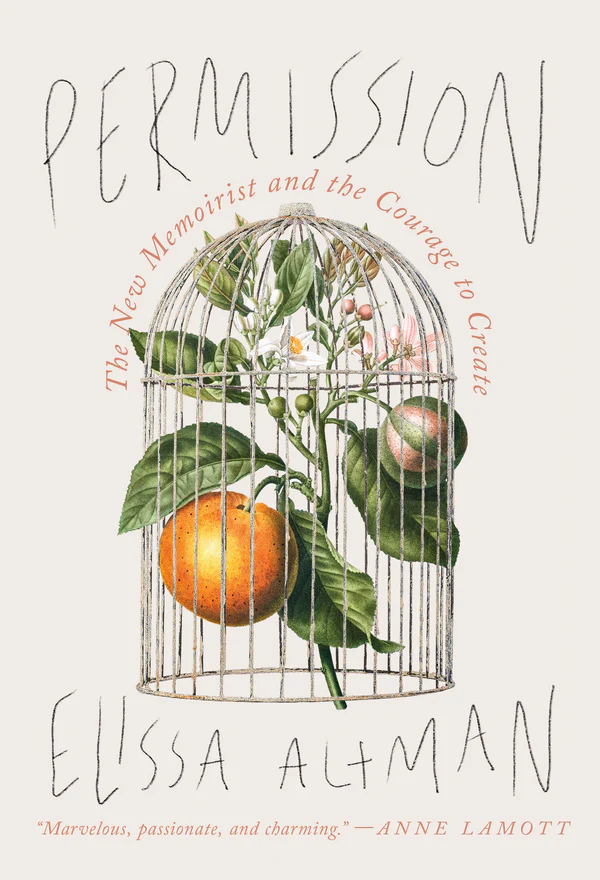
An article in Poets & Writers by Elissa Altman convinced me to read this. Other writers with subtitles like hers—The New Memoirist and the Courage to Create—have landed too deeply in the pool of self-help to suit me. And some have weighed heavier on the balance of personal reminiscence, allowing craft and creativity to drift.
Permission is the perfect temperature for me to wade in, and her love and respect for the memoir form splashes over the work as whole. Just as Stephen King’s On Writing includes a terrific list of recommended reading in the back, Altman does too. And, further, she quotes her favourites judiciously. About half the notes I made were quotations from other memoirists, which resulted in adding about a dozen books to my TBR.
Early on, for instance, she quotes Doris Grumbach when she describes how making “art from chaos creates an environment ripe for understanding, revelation, and, ultimately but not always, healing.” Grumbach notes: “We are what we were told we were.” Observes: “Rarely if ever did we think to look within for knowledge of ourselves.” And asks whether we averted our eyes because we were afraid.
Often, yes—that’s it, Altman says. And this is where Permission lives, in the quest to find a way to confront and cope with the fear of telling what you’ve been afraid to tell, with the ongoing need to tell the story you’ve been unable to forget.
Altman is self-aware and reflective, and she does not unilaterally and consistently ally with the storytellers.
She does value difficult stories, and she quotes Joy Williams in support of that view: “What good stories deal with is the horror and incomprehensibility of time, the dark encroachment of old catastrophes.”
Her belief in the inherent value of stories and storytellers is clear and uncomplicated:
“The process of storytelling is paramount to species survival—consider the cultural stories depicted on Greek pottery in 400 BCE, in which entire myths are played out pictographically—and to the metabolization of joy and sorrow. This is why stories and our compulsion for telling them exists in the first place: as a way of remembering who we are, where we come from, what we saw, and what we know to be the truth. And that is the right of every artist.”
But nuance prevails. The bulk of Permission resides in the responsibility of writers and artists to tell good stories, to query their intentions, to scrutinise their motivations:
“When George Saunders talks about having to get quiet and listen to what the work is trying to tell them he is leaving out the fact that we also have to listen to the work’s answer to why it is being made—why it wants to be made—and whether that answer is one that involves transcendence, or retribution.”
Her narrative is all-the-more powerful in the context of her experience of familial estrangement, in the wake of her having told a story that others wanted untold. The risk of judgement and unexpectedly high-stakes outcomes for writers who “say too much” is obvious. Undoubtedly, many writers will relate to the dilemma surrounding what to say and what not to say.
There are instances in which the language feels slightly over-blown: “Words allow the stories that haunt us to move through the scrim of imagination and into a place of breath and life.” But most writers have likely had some experience, however slight, of censure—whether based on something they have written or something they have considered writing. And that sensation of being silenced (or the related and more complex mechanism of having “chosen” to silence oneself) would have been felt so keenly, that sensation of feeling stifled or suffocated, that Altman’s offering—breath and life—will be gratefully received as a counter.
Besides, her talk of breath is connected to the broader question of inspire+ation. She views stories as being life-sustaining and essential. And she includes all relationships to story in that assessment: “The act of reading, of looking at art, of breathing in the stories that surround you: they are all vital parts of the writing process.”
Audience, however, is key. She outlines specific distinctions: “Notebooks are places for practice, for undoing the knots of distraction and shame that keep the work from breathing. Notebooks dilute overwhelm and stick a pin in jealousy and envy: they allow you to pour out whatever it is that needs pouring out, and move on to focus on the work itself.”
Writers who are content to journal have a certain requirement for permission (entirely their own), but writers who seek publication have an obligation—to their own story—to examine their goals. Both their nature and their timing matter: “Impact on others is a trip wire, a snare that has stopped more creatives in their tracks than perhaps anything else. These is no impact on others unless and until the art is made.”
And the timeline could vary dramatically: “Quiet is the peace that you find when, after a day or a decade, a week or a month, you allow yourself to crack open the story that you must tell in order to find its pulsing heat, and to devote yourself to it and the crafting of it as art.”
I suspect there will be many writers who purchase Altman’s book who do not even give themselves permission to read it for quite some time. But, when they’re ready, Permission will be waiting.
A powerful resource for a certain kind of writer.
Elissa Altman. Permission: The New Memoirist and the Courage to Create. Boston: Godine, 2025.