
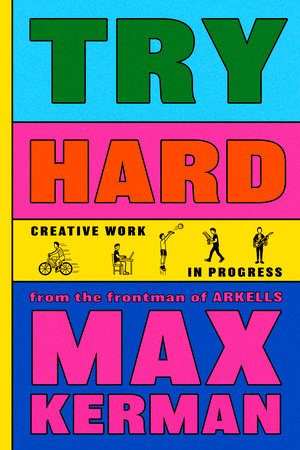
Try Hard landed in my stack thanks to an article in The Globe & Mail that suggested it was not just for Arkells fans: the subtitle—Creative Work in Progress—heralds its reach towards a broader audience.
Well, yes and no. There are many reflections on creativity that extend to many artforms and activities. But there are many specifics, about songwriting—but also concert lineups and career management and development, that it’s clear fans would enjoy this book more than a casual/occasional listener.
Nonetheless, the format (short essays, perfectly timed for a coffee break) and the style (informal, but tightly constructed) conspire to make for a satisfying read. And I do enjoy finding the advice embedded in series of reflections, rather than self-help-y bullet-points and text boxes: Kerman’s narrative is well-constructed and feels like a conversation rather than an instruction set.
About a third of the way into the volume, Kerman makes this observation: “If you want your own art to get better, the first step is observing how other artists do it.” He actually refers to Stephen King’s book On Writing at one point; King’s version of this advice is that writers must read (and King includes a fabulous list of recommended reading in the back of his book too).
Fans would enjoy reading Kerman’s reflections on concerts he’s attended by the artists whom he credits with teaching him how to create memorable live performances. Also his description of the balancing act of adhering to a thoughtfully constructed set-list with the need to spontaneously adjust in response to a reserved/disengaged group.
But more enjoyable for me, is the way he describes other people’s way of interacting with the arts—with the world around them. Like Jim [Creegan, of the Barenaked Ladies], described as “sixteen years older than I am, but he acts like a sixteen-year-old when he’s talking about music. I want to hold on to some version of that feeling forever.”
And not just famous folks, but also Kerman’s father. He’s so spoilerphobic about movies, that he opts to leave the room whenever a conversation erupts about a new one and, at the movie theatre, wears headphones during the trailers, to create a sort of buffer for the film. He “remembers the feeling of seeing a movie without knowing anything about it, and he’s determined to experience it again. His strategy allows him to interact with art in a way that excites him.”
Kerman metaphorically plugs his ears when there’s talk of ticket sales for the band’s performances too. “The only time I want to know about a show’s ticket sales is if it’s sold out so we can make a social media post about it and carry on. Otherwise, I’ll assume that every show needs a bit more work.” A writer’s version of this could be avoiding reviews as well as sales information. Only James Patterson and Stephen King regularly find their position on a bookselling behemoth’s bestseller list inspiring.
In a general way, I appreciate the simple and direct advice like this: “Today, I work at a pace that doesn’t allow much room for imposter syndrome.” And this: “There is a fine, but important, line between a routine and a superstition.”
In a personal sense, I appreciate his way of writing about how pursuing your passion can be all-encompassing: “Because so many of my interests and passions exist within my job, it’s often hard to turn off. Even though my life is centred on my passion, it’s important to have moments of space. Moments away from work to play can reinvigorate my process.” Sometimes I spend too much time with words, so much time that I forget to do other things—take walks, weed the garden, look at photographs, watch films—and it not only sucks the joy out of words, but eventually I find myself writing in circles.
One of the books that Max Kerman acknowledges as a positive influence is Rick Rubin’s The Creative Act, which disappointed me because it did not credit other artists and their experience and wisdom, even when he included their ideas. But Kerman creates his own sources often and clearly, so neglecting to do so is not what inspired him about Rubin’s book.
Kerman gets full marks for me on the sense of wanting to collaborate rather than dictate. And for making it so simple, in the end: try hard.
Great stuff for Arkells’ fans; good stuff for writers.
Max Kerman. Try Hard: Creative Work in Progress. Toronto: PRH-Viking, 2025.