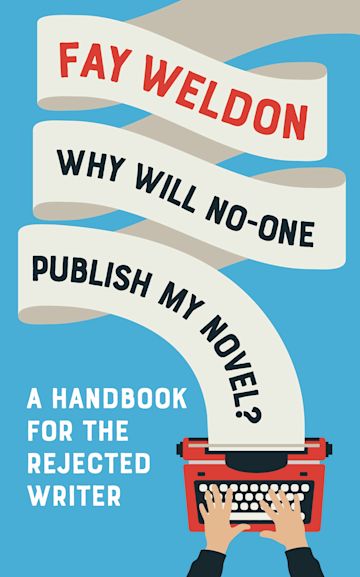
Why Will No-One Publish My Novel? (Fay Weldon)

Because I enjoyed all the talk of writing in her autobiographical Auto da Fay (2002), I was excited to see this palm-sized volume on a remainder shelf.

But, honestly, I wasn’t expecting much: its size and length suggested someone had been thinking more about marketing and stocking-stuffer possibilities than its contents.

There is concrete and helpful advice here. As the subtitle indicates, Weldon is writing “A Handbook for the Rejected Writer” but, of course, that’s every writer, to some degree.

There’s comic potential and Weldon puts it to work. What are your options when you’ve received yet another rejection? “You can spend the rest of your life disappointed and aggrieved,” she posits, to start. But she present hands-on solutions too.

No quick-fixes, but reliable problem-solving. “So look for what you were trying to say in the first place. It’s in there somewhere, the good idea that launched the whole process: the loving phrase spoken, the hateful comment made, the telling conversation overheard, the news item read—whatever it was that impelled you to take up your pen or keyboard.”

She’s a career writer. “Readers, I would suggest, don’t much change over the centuries,” she suggests.  “They like a good simple robust story: a lot of sex, a hint of mortality, to be made to laugh, to be made to cry and with any luck, to think.” There’s the basic outline for success (i.e. to avoid further rejection). With one solid solution: “So provide it.”

There are many reasons why an editor or agent might not connect with a writer’s work. She’s often quietly funny when describing them:

“This [too much fine writing, too little plot] too can happen. You’ve been a natural writer since you took up a pen. Teachers have marvelled at your skill with words, the beauty of your prose, your astonishing gift for metaphor and so on. It’s not just your mother who thinks you are wonderful, but colleagues and established writers who wish they could write as well as you. But the fact is you’re not a novelist, you’re more of a poet, though since you write to the end of the line you haven’t realized it.”

Sometimes her humour is bolder. She writes a funny scene about how things go awry in a publishing house. “This is the worst possible case,” she admits, “but I had fun writing it, and these things happen. If it has, don’t give in, take steps.” Partly due to the nature of the book, compact and concise, the focus of her advice is to act.

One limitation of this volume’s size is the limited capacity to refer to other writers’ work and experiences, to recommend other volumes on craft. There are a few references in the text, like Graham Greene’s advice on intuition, which Weldon summarises: “A story has no beginning or end: arbitrarily one chooses, the moment of experience from which to look back or from which to look ahead.”

There are two Gone Girl references wedged in with the classic examples and nine recommendations on the last page (two Vonneguts). Writers looking for contemporary references must look elsewhere. But Weldon makes the classics work: “Hardy worked from press cuttings for Tess of the d’Urbervilles, Flaubert for Madame Bovary; don’t be sniffy.”

Ultimately, Weldon rests on the oft-repeated truth: “All novelists go about things differently. There is no one way of doing anything.” Which is a comfort, after she’s shared so much of her own way.

A useful resource for writers.

Fay Weldon. Why Will No-One Publish My Novel? A Handbook for the Rejected Writer. London: Bloomsbury, 2018.
Chatty Review of Alice Sherman Simpson’s The Winthrop Agreement

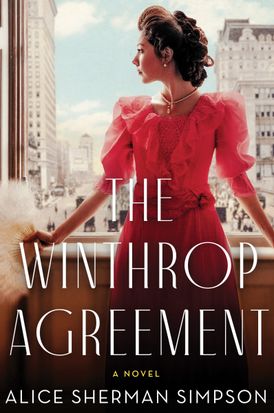
The cover of Alice Sherman Simpson’s The Winthrop Agreement conjures up a certain kind of reader and, frankly, it’s not my kind. At least that’s what I first thought.

Picture this: a young woman in profile in front of a window, looking away from the reader and indirectly at the slightly unfocused, sepia-toned skyscrapers of historic New York City behind her, her brilliant coral lace-and-taffeta dress and rosy skin a startling contrast until it fades into darkness that affords the perfect backdrop to a sophisticated font.

It’s been invited to the same party as the book covers of Paula McLain and Tatiana de Rosnay, and the blurb describes it as “[p]art history, part romance, with a twist of gothic” and refers to “Bridgerton”.

But I read Simpson’s Ballroom, her 2014 debut novel, rooted in linked narratives that, cumulatively and deftly, prompt profound questions about relationships. About how we connect and disconnect from others around us. And how we pursue and create the futures we imagine for ourselves—sometimes tragically.

The Winthrop Agreement ranges from 1893 to 1928 and, stylistically, it straddles a dedication to historical accuracy, but recognises that modern readers often prefer an anachronistic approach to storytelling. Don’t let the facts stand in the way of falling fast into a story.

You can practically see the folders stuffed with Simpson’s notes—world events and characters’ experiences for each year in charts and timelines—and the stacks of reference books lurking on flat surfaces in her study. There’s no doubt she’s done her research, both deliberately and accidentally (by consuming other people’s historical fiction and older novels).

It’s also unsurprising that Simpson is a visual artist with a particular interest in dance. Her scenes are so acutely imagined, that there were moments where I felt like I was reading the prop department’s notes for a limited series on TV or a classic Merchant-and-Ivory-styled film.

At first this slowed my roll, especially as the headings for each year seemed to accentuate how deliberately time was passing at certain junctures in the characters’ lives. (This way of marking time reminds me of Amor Towles’ A Gentleman in Moscow, another historical novel segmented into years, where some years are encapsulated on a single page and others require dozens for their account—because, as in real life, some years are pivotal and others routine.)

It’s true that Ballroom was more tightly constructed—orchestrated, even—right from the start, but the opening chapters of The Winthrop Agreement evoke one of my favourite novels about a young woman born to an immigrant family in New York City, who must find her way in a world which offers every opportunity and no opportunity: Betty Smith’s A Tree Grows in Brooklyn.

When Mimi became my Francie, I was hooked. And Miriam’s view of the city from the rooftop is akin to Francie’s fire-escape view:

“…she felt like she could see the whole world from he sixth floor. She could see both down-and uptown: the buildings, the river, the ever-changing cloudscape in the sky, and the waves of laundry on lines stretching from building to building, dancing in winter, motionless in summer.”

Simpson’s attention-to-detail captures more than it seems. Sometimes it’s all about the visual but sometimes the novel’s themes are encapsulated there. As with this garment: “She wore a swan-bill corset, all the rage in Paris, to create an S-curve torso shape despite how uncomfortable it made her.” Readers can imagine the garment’s appearance, but its symbolic importance reminds us of the confinement and challenges faced by women of that era.

The wealthiest women’s corset strings are pulled the tightest, and this novel is all about class. Beginning with a young woman’s arrival at Ellis Island. Mimi is not a Winthrop, and most of what she knows about the wealthy comes from novels she’s read. This is how she understands privilege, by first observing it on the page and then, much later, observing it in the world around her:

“Young wives held their husbands’ arms while pushing babies in proper prams. It was the world she knew about from Edith Wharton’s books—one of quiet refinement. Not illustrated figures from Vogue or words in a library book that fed her imagination but one in which she could turn round and round and see in its entirety.”

This is where the novel’s conflict is rooted, too: in privilege. Particularly in how it’s levied by men against women, by the wealthy against the working-class. “The Winthrops are very smart people,” Mimi is advised: “They are part of Society—the Four Hundred.” (There are, however, characters who challenge the status quo: as Mimi’s experience expands, she finds supporters who have and lack access to wealth.)

One of the most satisfying elements of Simpson’s novel is how naturally she reminds us of her story’s context in bookish terms with artsy specifics. As when we see Mimi borrow a Kate Greenaway book from the public library to read to her neighbour, the premiere performance of Dvořák’s New World Symphony at Carnegie Hall, or tickets tucked inside a copy of Willa Cather’s Oh, Pioneers!

So even if I’d rather have seen a young girl with her library books on a Brooklyn fire escape on the cover, The Winthrop Agreement is a really good read: don’t let the taffeta and tulle put you off!

Published by HarperCollins and HarperPerennial US and HarperCollins Canada

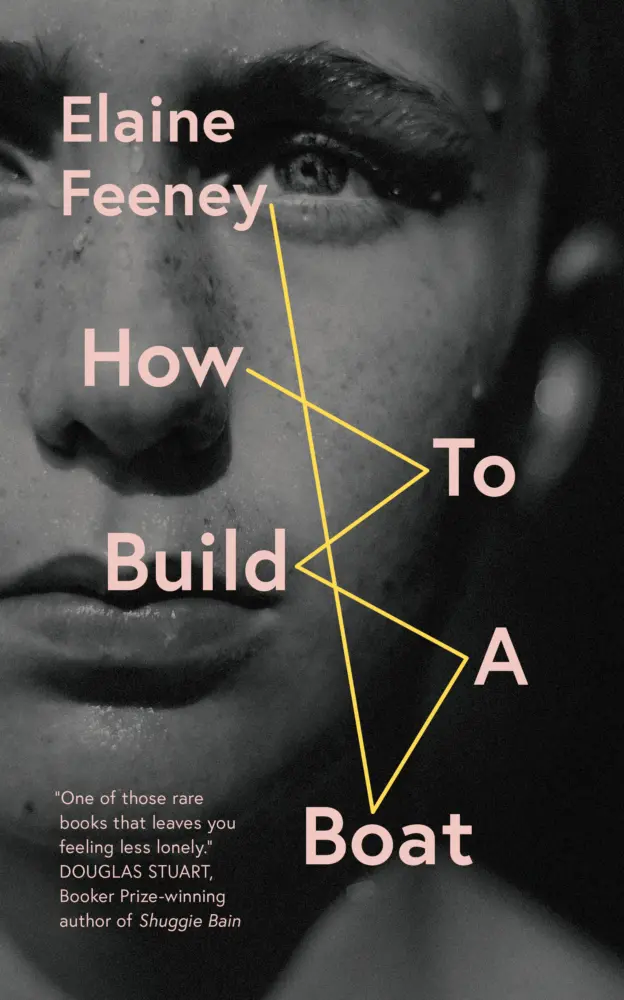
Experimental Review of Elaine Feeney’s How to Build a Boat

You start by building a strong back, a long wooden beam.

It begins with an epigraph, from mathematician Maryam Mirzakhani: “There are some times when I’m in a big forest and I don’t know where I’m going. But then somehow I come to the top of a hill and I can see everything more clearly. When that happens it is really exciting.”

So, you should know: you’re heading into the forest now. Anticipate an uncharted climb.

You mount the furnished uprights to your strongback and then mount two frames to the uprights.

The narrative begins with Jamie’s memories, then alternates between thirteen-year-old Jamie’s voice and the voice of his teacher Tess.

You temporarily attach the stringers (the long piece of wood that run from one end of the boat to the other) to the two frames and then start inserting frames.

Both voices throb with the kind of detail that makes you flip to the writer’s bio, convinced they’re both a thirteen-year-old boy and a married teacher in county Galway, Ireland.

Next, trim the ends of the stingers to fit the bow and stern.

Jamie endlessly rewatches a two-minute-and-eight-second-long video of Noelle at a school swim-meet, years before she would become his mother, before she would die giving birth to him; he believes his uncanny mathematical skill can be employed to build a Perpetual Motion Machine to connect him to his mother. At last.

Tess has repeatedly engaged in IVF and contemplates one final attempt; she believes that conceiving and raising a family will finally secure her future with her husband and her identity as a caregiver and their identity as a family. One last time.

Once that is done you start to lash the frames together.

The two characters’ lives grow increasingly enmeshed as Tess is assigned to monitor Jamie at school, his progress and his struggle to navigate the gap between his experiences of the world and most other students’ experiences.  And the questions that Jamie poses challenge Tess’ expectations and accentuate a gap between what she has always imagined herself wanting and what she truly desires.

You sand and do any touch ups that are necessary at this point. Then oil the frame and it’s ready for the skin.

The scenes (at school, at home), relationships (between students, between lovers), language (dialogue unmoored, interior musings proliferating) and style (often poetic, occasionally distanced) are vivid and rich. The construction seems effortless, which suggests an exacting attention-to-detail and gradual, methodical accumulation of tension—embodied in the characters’ urgent pursuits, as they move from paralysis to readiness.

Once your skin is sewn on you have to seal (waterproof) it.

Each character’s experiences escalate, a sense of confinement slowly swelling, until it seems that their sense of breathlessness is yours. Nothing really happens, but everything actually happens, and there is a boat after all, and you were in it the whole time. And when you turn the final page, you feel as though you’ve been prepared for a journey that you didn’t know you were taking, in a quiet but determined fashion—and there is hope where there was none before.

Then you just add any deck rigging, a seat and back band and off to the water you go.

[Note: Thanks to KudzuCraft for the inspiration I found in their Basics of Building Boat page for writing an experimental review of Elaine Feeney’s How to Build a Boat (Biblioasis, 2023).]

300-word Review of Stephanie Chitpin’s Keep My Memory Safe

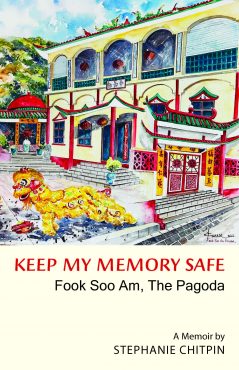
In Keep My Memory Safe (2023), Stephanie Chitpin reflects on her 1970s childhood in Mauritius—in a Buddhist temple and on Rue Leoville L’Homme in Chinatown, on her immigration to Canada as a young adult and, ultimately, the complex process of reconciling her origin story with her evolving understanding of belonging.

In fewer than two hundred pages, in spare but evocative prose, she describes the individuals who profoundly shaped her values, identity, and choices. Most often clear-eyed, occasionally lyrical, she situates herself as a child in a series of scenes—those from daily life in the pagoda and Mr. Chui’s teashop are particularly vivid—but offers an adult’s interpretation alongside, so that readers have the sense of fully inhabiting her perspective across time.

As when her guardian Ah Pak discovered the fountain pen that Chitpin received for scholastic achievements, for instance:

“She put up a front as if she was angry at me for spending so much time on my studies instead of reading the scriptures or chants. However, I suspected she was proud of my achievement and successes. I witnessed exchanges between her and the Chui family, where the latter would complain about Park’s poor performance. I could tell she was silently proud.”

Her readers benefit from her present-day capacity to unravel complicated, even contradictory, psychological responses and emotional experiences.

The inherent power of Chitpin’s narrative is the reverberation of authenticity and vulnerability. She confronts painful truths in the process of understanding how she was brought from Hong Kong to Mauritius, where she was raised as an orphan in the Fook Soo Am temple, and schooled to be grateful for a life of service.

A detailed and deeply moving memoir, worth reading and rereading for its wisdom and tenderness.

Publisher: Baraka Books

Craft in the Real World (Matthew Salesses)

Clearly stating his intention from the start, Matthew Salesses’s Craft in the Real World is an invitation to discuss the foundational ideas and practices that define writers and their work.

“This book is intended to begin further conversation—it should never be taken as an exhaustive or definitive resource,” he says. And, because “craft is in fact nothing more or less than a set of expectations”, that conversation may range widely.

[And, speaking of conversations, I’d heard about this book, but it wasn’t until I saw Rebecca Upjohn‘s recommendation, her describing how it had impacted her thinking and reading, that I decided to purchase a copy myself.]

Up for discussion are not only the stories that have been analysed, lauded and celebrated, but also the stories that have been neglected, misunderstood, and overlooked:

“Craft is the history of which kind of stories have typically held power—and for whom—so it also is the history of which stories have typically been omitted.”

He references other writers and thinkers who value and prioritise difference and views himself as part of a community that aims to broaden the understanding of stories told as well as the power dynamics simmering beneath the decisions at work in their telling, in their reception, and in their proliferation.

Like many others, he quotes Audre Lorde: “There are no new ideas. There are only new ways of making them felt, of examining what our ideas really mean.” Because I’ve been rereading Lorde’s essays of late, and had recently finished Alexis De Veaux’s biography of her, I felt like I was contributing to this discussion. But with his reference to Toward the Decolonization of African Literature (Chinweizu et al.) and the four conventions identified therein about the tradition of incorporating the fantastic into everyday life, I felt like a student, reaching into my reading experience to locate stories that fit with these conventions.

(Curious what they are? First, the spirit beings have a non-human trait that gives them away—like floating—and second, a human’s visit to the spiritland involves a dangerous border-crossing, and third, spirits not only have agency but can possess humans and, finally, spirits aren’t subject to human concepts of space/time. If I had understood this when I read Ben Okri’s The Famished Road after it won the Booker Prize, I wouldn’t have had quite so many questions!)

In imagining myself in conversation with these essays, there were times where I disagreed, but although he presents his ideas with certainty and authority, there is something about his tone which suggests that he might enjoy the process of broadening the conversation to include disagreement. Having read Ursula K. Le Guin’s essays about writing the Earthsea stories for instance (not only the original trilogy, but the volumes and stories that followed), I believe her intentions are slightly different than he understood them to be, in the context of their original publication, and I think that would be a rewarding conversation to explore, particularly in the context of how some of the later stories differ from the early ones. I don’t think this is the kind of discussion that has a resolution…the merit is in having the discussion.

Despite the volume’s compactness, Salesses is committed to nuance. Despite his spare prose, he’s prepared to get gritty. (“Diversity,” he writes, for examples, “in the parlance of our times, should not be tokenism.” Not everyone is prepared to acknowledge a distinction.)

He’s also prepared to admit that needing to have certain conversations doesn’t mean that we are prepared to do so. He writes: “It’s impossible to trace an entire tradition, including its experiments, in a single essay—this is the point. Writers must read much more widely and much more deeply, if we are to know enough craft to start to critique other writers fairly and to write truly for ourselves.”

There are plenty of references for readers who are just beginning to explore literature, just beginning to broaden their understanding of it, but Salesses admits that the work required to change conventional understanding of craft resides outside the scope of any single book, including his own.

One of my favourite passages in the books is this: “I believe in workshop as a shared act of imagination, in the ability of many minds to foster the growth of one by one by one through conversation. I believe in the vulnerability of process and the process of vulnerability.”

At first, maybe it sounds like all the most commercial parts of workshop culture, heavy on trendy words and light on meaning but, on closer examination there’s a profound idea there that I’ve longed to articulate myself. It’s harder to be vulnerable by engaging in a process these days, to reflect on it and adjust as necessary, than it is to adopt a position of certainty (or conform to someone else’s) and defend it loudly.

There’s a lot of theoretical material here, but Salesses gets practical too. I’m particularly fond of this bit of advice to writers who are evaluating another writer’s work: “Be specific and precise, and ask questions you don’t know how to answer, and give suggestions that come from reading the story for what the author wants it to be, not what you want it to be.”  (He’s speaking about the workshop environment, but the underlying concept is also valid for reviewers.)

His “Syllabus Example” is the first piece I’ve read that made me feel a little less crazy for writing so many notes about my own writing as a means of exploring intentions and results (sometimes a word count that competes with the length of the work itself!). I photocopied three of his 34 Revision Exercises and filed them with a simmering WIP. And I flagged “A List of Craft Questions to Take into Consideration” because it looks useful. (He presents these pieces as beginnings, a foundation for further development.)

A fine resource for writers.

Matthew Salesses. Craft in the Real World: Rethinking Fiction Writing and Workshopping. NY: Catapult, 2021.

And a Dog Called Fig (Helen Humphreys)

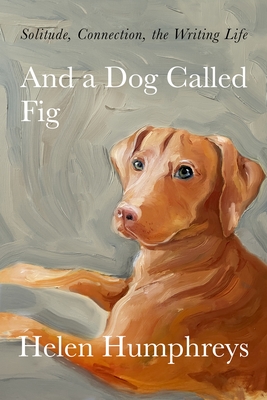
This is a most suitable companion for last autumn’s resource, Miss Chloe, in which A. J. Verdelle considered her relationship with Toni Morrison in the context of Verdelle’s life of letters, as reader and writer. Here, Helen Humphreys considers her life as reader and writer in the context of the relationships she’s had over the years with her dogs—most recently, Fig.

It’s hard to imagine this book without the dogs, and even though I’ve never had a years-long dog friend, I flagged several passages about them. “If all else fails in a conversation,” Humphreys notes, “particularly when writers are forced to socialize with one another at a literary event, I know that if the person I am speaking with has a dog, we will never run out of things to say.”

When she talks about Fig’s fidgeting while trying to prep her for a walk, she discovers an unexpectedly simple solution:

“I can’t believe I didn’t think of this before and have been fighting her this whole time when instead I could have just let her hold something in her mouth and made the whole enterprise much easier. Another example of the way a dog tells us what to do with them, and if we’re paying attention and not fixated on having our way, by listening to what they’re trying to communicate, we could get along with them better.”

Organically, from this realisation, this emerges: “This is not dissimilar to writing, where it is more effective to listen to intuition instead of trying to force your will upon a piece of work.”

She seamlessly stitches the two topics together, structurally and granularly: her relationships with dogs and her relationships with creative projects. And just as each dog she has loved is unique in her experience, so each book has been: “Each new novel requires that everything be learned all over again, because no two books are alike, and there are different sets of problems requiring different solutions when creating each one.”

Humphreys also contemplates the relationship between reading and writing: “It was reading that made me want to be a writer. I had cried uncontrollably for an entire day after reading Charlotte’s Web and was so affected by stories—unable to separate them from real life—that I decided the only way to loosen their hold on me would be to create them myself, because then I would know what was coming in the story and wouldn’t get so upset.” As a young reader and burgeoning writer, she could have selected several stories to illustrate her point, but E.B. White’s novel is perfect in the context of her relationships with four-legged and wild creatures.

For those familiar with Humphreys’ work beyond this book, there’s an additional layer of interest as she discloses elements of process for specific projects. About Leaving Earth, for instance, she writes: “I couldn’t figure out how to transition from one scene to the next, so I simply ended a scene and moved on to another one. This made the pace fairly quick, which, luckily for me, suited the story I was telling, so the short scenes don’t betray my lack of ability, and instead seem to be there as a deliberate device.”

And readers familiar with her body of work will not be surprised to find grief a central tenet here: “The natural world became even more important to me than it had before, and the smallest wonder in it was enough to calm my spirit for another day.” Her prose is spare, which affords the opportunity to deep emotion to settle between the sentences and paragraphs: readers coping with a recent or long-ago loss may find additional comfort here, perhaps unexpected in a volume which also contains valuable writing advice.

And A Dog Called Fig is a meditative and tender book about loneliness and companionship, love and grief, based in reflections on a life shared with dogs and shared with story; Helen Humphreys illuminates that the way we build (and lose) relationships is not all that different from how we create (and release) narratives into the world.

An excellent resource for writers.

Helen Humphreys. And a Dog Called Fig: Solitude, Connection, and the Writing Life. Toronto: HarperCollins, 2022

Miss Chloe: A Memoir of a Literary Friendship with Toni Morrison (A. J. Verdelle)

A. J. Verdelle chronicles not only her friendship with a renowned writer, but also her own personal relationship with words—as a reader and as a writer—and the development of this lasting relationship over the years. About three dozen pages into the volume, this quotation reveals how she found her community:

“Eventually, of course, I developed acuity enough and autonomy enough to choose more deliberately, more cautiously. I chose Morrison frequently, and from a thrumming list of others: Maya Angelou Alice Walker, Julia Peterkin, Gayl Jones, Toni Cade Bambara, June Jordan, Paule Marshall, Zora Neale Hurston. Much later, I read Ann Petry and Nella Larsen. Reading this roster of Black women helped me understand that Morrison was not writing alone.”

So many of these names are familiar to me (but I would have added Terri McMillan, Bebe Moore Campbell, Shay Youngblood, Gloria Naylor, Dorothy West, Marita Golden, and April Sinclair) that I knew I would enjoy this volume, if only for Verdelle’s thoughts on reading. She writes: “If you let a Black girl loose in a library, you may not recognize the woman who emerges.”

Her discussion of the vital importance of other writers’ words—to her personhood and her creative work—is impassioned: “We/I owe so much to books. Books changed my sight lines, my expectations, my sense of the enormity of time and the complexity of humanity.”

This theme continues through her account of the years that Toni Morrison herself spent in editorial work. Questions she poses from Morrison’s point-of-view remain valid today: “Why shouldn’t we stand on shelves in the libraries? Why shouldn’t our spines be straight? Why shouldn’t she change which books were published?”

Verdelle celebrates the act of reading generally, but also reading Toni Morrison specifically. Close rereadings of Morrison’s work lead to incisive commentary about individual narratives and characters, Morrison’s oeuvre, and her overarching intent and underlying preoccupations:

“Morrison’s novels are full of teenage girls showcasing or dramatizing the discoveries, the misdirections, and the assaults that implode and plague their lives. Even as the decades pass for the characters, and they mature into parents and grandparents and exhausted observers, still, the novels spotlight teenager girls.”

For those who explore Verdelle’s memoir with the experience of only one or two of Morrison’s novels, there are plenty of passages to tempt further exploration:

“If you look, you will find specific reflections on complex and straightforward human endeavors, including handling atonement and forgiveness (complex) or cooking soft-boiled eggs (straightforward). You can find full treatises on slavery, naming, Reconstruction, and the Jazz Age. You can find secondary treatises on the Korean War, Black posterity, Black women’s friendships, mothering. You can also find ribbons, and red velvet rose petals, and a clearing in the woods where a woman can preach.”

Inextricably intertwined with her love and respect for reading is Verdelle’s desire to write. “Writing had been what I’d wanted to do,” she explains, since “well, since learning that somebody wrote everything I was reading.” Many of us who are compelled to write can recall the moment at which we realized that someone—a person—wrote the words inside of books. Verdelle’s tone—so direct and clear—includes her readers in this conversation. It feels, as we absorb her relatable prose, as though she has already included us in her circle.

This circle includes everyone who has influenced her work, including James Baldwin who, Verdelle writes, “famously said that writers have eighty million decisions to make. (So get busy.) The number is not an exaggeration.” (This immediately becomes one of my favourite observations about writing life!) Sometimes she carries on to make specific suggestions, following another writer’s advice, as in this instance: “So, those of us who intend to write need to build our decision-making skills. And we need to make all those decisions against our human backdrop—the ticking clock we know as mortality.” Her natural inclination to twin commentary on both art and life ensures that readers are attuned to the universal elements at work, so I suspect creatives of all sorts (not only writers) would find value here.

Verdelle returns, consistently, to Morrison, however. And because she has the experience of a long-time friendship with the writer, there are additional layers to reflect upon, in comparison with another writer who could only glean wisdom from Morrison’s own writing or lectures about the craft of writing. For instance: “From writing, we learn the power of the pause; from Morrison, I learned about power in pause in person. I am neither afraid nor made uncomfortable by pause, by silence, by moments where thoughts make their connections, rendezvous in sit. Some pauses are pregnant and worth the wait.” (And, if you’re wondering, their friendship had its challenges.)

Most often the advice is Morrison’s, or is rooted directly in a consideration of her work. For instance: “Morrison expected that writers would take on the task of independently teaching themselves. Regulating their own lives, their own writing practice, their own schedules.” The importance of initiative and self-regulation, especially for freelancers, cannot be overstated.

Verdelle is not dismissing more formal education, though she doesn’t overlook its limitations: “Imagination can only be nurtured; technique can be taught, identified, explained.” And, because she is herself an accomplished writer (her debut novel, The Good Negress was a critic’s darling in 1995), she has her own advice to share. Consider: “Characters blister their feet on the roads in their environment, their era. We writers have to recognize, and sometimes set aside, the lens of now.”

Though particularly rewarding for me, combining elements of a bibliomemoir with a chronicle of a literary friendship which includes one of my personal favourite writers, A.J. Verdelle’s Miss Chloe is rich and thought-provoking enough that readers with only one of these inclinations will find it a rewarding read.

Great stuff for writers.

A. J. Verdelle. Miss Chloe. NY: HC-Amistad, 2022.

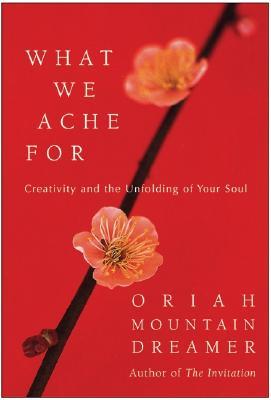
What We Ache For: Creativity and the Unfolding of Your Soul (Oriah Mountain Dreamer)

Simply by reading the title and author’s name, you will have an inkling of whether or not there’s a match to be made between you and this book. There’s the prominence of the word ‘soul’ for one thing, and the fact that the author adopted this name based on a message she received in a dream for another. And if you are the kind of person for whom an inkling matters, you are in good company and, if you count Natalie Goldberg among your favourite authors of books about writing and you have completed (or dreamed of completing) Julia Cameron’s The Artist’s Way, you will feel like you’ve found your circle.

The emphasis on spirituality and personal growth did not suit my current frame of mind (and, further, I was craving a book on creativity in general, not about writing specifically) but I was encouraged to read on by this passage: “We have to let go of our ideas about ideal conditions for beginning if we are going to start.” With my work routine disrupted by a recent move—and compounded by a protracted illness—I struggled to focus; this simple concept (familiar, but freshly present, and in print) snapped my resolve into place.

What kept me reading was the author’s reference to one of my favourite writers (“reading the book The Stone Angel by author Margaret Laurence…made me want to write”) and to a writer whose work I have admired in general, whose work felt particularly pertinent with Russia’s war on Ukraine, the ongoing war in Ethiopia, unrest in Lebanon and continued conflict in Syria:

“Susan Griffin’s books Woman and Nature: The Roaring Inside Her and A Chorus of Stones: The Private Life of War are two that repeatedly reinspire me to remember the mysterious process whereby writing or any other creative endeavor, can reveal the wholeness of life and the meaning embedded in interwoven colors and sounds and stories.”

I was reassured to discover this truism on these pages: “Sometimes it just takes a shift in perspective to help us see the world a little differently, to spark the imagination in new ways.” And I, too, took comfort in the works of others, while I felt unable to do my own work: “Getting in the mood to do our own creative work may mean deliberately cultivating our connection to a particular expression of someone else’s work.” At times, I marvelled at the room in these new surroundings (both indoors and outdoors) and thought that this might be true for some—“Too often we have little sense of spaciousness in our lives”—but, for me, broader spaces felt disorienting and strange.

At the end of each chapter, there are things to think about, sometimes things to write about. Mostly, the text seems to speak directly to a single reader, but occasionally it’s clear that the audience is a group or class, working through the book methodically and collegially.

In the “Doing the Work” chapter, readers are invited to complete the following phrases:
“I am committed to…
I find it difficult to persevere at…
I am patient with…
I am impatient with….”
Although likely most useful for those who write primarily for personal growth, What We Ache For contains some solid advice.

Fair stuff for writers, good stuff for journallers.

Oriah Mountain Dreamer. What We Ache For: Creativity and the Unfolding of Your Soul. San Francisco: HarperSanFrancisco, 2005.

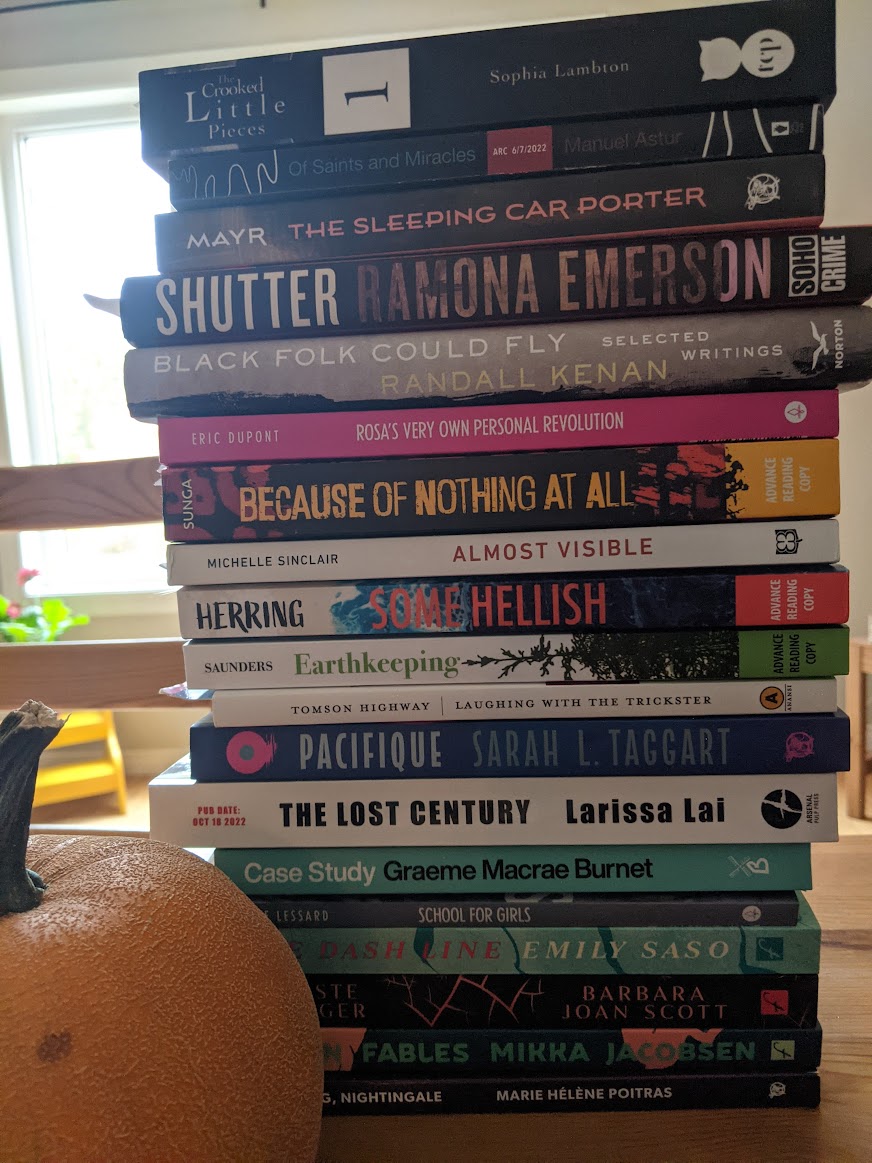
An Avid Reviewer’s Reading Copies: Autumn 2022

Some of the pitches I’ve made-to review or discuss these new and forthcoming works-will likely land after I publish this, but I would be pleased to review all of these books, which are roughly listed in publication order.

If we’ve worked together previously, let me know your time-frame, and if you’re interested in working together for the first time, please share your rate information and specifics about your revision schedule. (This is only the third time I’ve posted a list like this: it worked well, but I’m not considering it a regular feature here yet.)

Sophia Lambton published this novel under her auspices at the crepuscular press. Her pitch revealed that she’d taken a peek at my reading preferences and she tailored the email in such a way that I was drawn into her passion for the story quickly.
ANY EDITOR SEEKING COVERAGE, please reach out.

Manuel Astur’s Of Saints and Miracles from New Vessel Press is “a sensual portrayal of an outcast’s struggle to survive in a chaotic world of both tragedy and magical splendor” in translation by Claire Wadie.
REVIEW SPACE SECURED.

Suzette Mayr’s The Sleeping Car Porter from Coach House Books has already been listed for the Giller Prize. As I’m familiar with her backlist, I’m particularly keen to cover this novel in the context of her body of work.
ANY EDITOR SEEKING COVERAGE, please reach out.

Ramona Emerson’s Shutter is a debut mystery from Soho Press, which also recently released the third novel in Marcie Rendon’s Cash Blackbear series; these Indigenous mystery novels would fit perfectly on the shelf next to Thomas King’s mystery series featuring Thumps DreadfulWater. Entertaining but quietly informative too.
ANY EDITOR SEEKING COVERAGE, please reach out.
REVIEW SPACE TENTATIVELY SECURED.

Randall Kenan’s Black Folk Could Fly is likely to end up on my list of favourite reads for this year. Discovering his work a few years ago, I pitched to review If I Had Two Wings, and then took the opportunity to read through his backlist, which is fantastic. W.W. Norton.
ANY EDITOR SEEKING COVERAGE, please reach out.

Eric Dupont’s earlier fiction has impressed me and made me laugh out loud. I pitched to review Rosa’s Very Own Personal Revolution, in translation by Peter McCambridge, before I even read it, and it did not disappoint. The latest in QC Fiction‘s voice-driven and expectation-shattering line.
REVIEW SPACE SECURED.

Paul Sunga’s new novel from Goose Lane is Because of Nothing at All, which Sharon Bala describes as a “thoroughly absorbing read: a deep dive into capitalism and foreign aid that lays bare the limits of the latter, in the face of the former, and the absurdities of both.”
ANY EDITOR SEEKING COVERAGE, please reach out.

Michelle Sinclair’s Almost Visible is a debut novel that explores “cultural and personal memory…[and] reflects on what can happen when a lonely person intervenes in another person’s life.” An epigraph from Simone Weil suggests this will be an interesting read from Baraka Books.
ANY EDITOR SEEKING COVERAGE, please reach out.

Nicholas Herring’s Some Hellish from Goose Lane has already appeared on a literary prizelist. With a comparison to David Adams Richards on the cover, this is likely to veer towards the melancholic, but just leafing through the vivid writing and detail looks to balance that out.
ANY EDITOR SEEKING COVERAGE, please reach out.

Also from Goose Lane, Gary Saunders’ Earthkeeping fits with the climate crisis and nature reading I’ve done in recent years. Because he has published many volumes in this sector, I’m keen to experience Saunders’ latest.
ANY EDITOR SEEKING COVERAGE, please reach out.

Tomson Highway’s Laughing with the Trickster would have landed on my stack even without a reason. I’ve grown to love trickster stories, Highway is one of my MustReadEverything authors, and I’ve listened to so many of the Massey Lectures that I’m starting to think I should make a project of reading through the gaps. Anansi.
REVIEW SPACE SECURED.

As a sucker for a good love story, my interest in Sarah L. Taggart’s Pacifique was immediate and pressing. I’m expecting this to be somewhat unsettling but clever. Another provocative read from Coach House Books, it seems.
ANY EDITOR SEEKING COVERAGE, please reach out.

Reviewing Larissa Lai’s The Lost Century was my first commissioned work. The ARC took longer than expected to arrive, which made me anxious and, then, I could tell within a few pages that I was going to need tiiiiime for this one: every detail counts but the prose seems effortless and the structure organic. Sometimes it’s more challenging to review a novel that I have really loved, but that’s a terrific problem to have. Arsenal Pulp.
REVIEW SPACE SECURED.

When I pitched to review Graeme Macrae Brunet’s Case Study, published by Biblioasis, it was before it had been listed for the Booker and before I’d read any of his other books. On a library browse, now some years in the past, I’d read a chunk of his debut novel (short-listed for the Booker more than five years ago) and loved it…in short, I was looking for an excuse to read his backlist.
REVIEW SPACE SECURED.

Ariane Lessard’s School for Girls (translated by Frances Pope) looks deliciously creepy. A couple of other books from QC Fiction have eerie-ed me out, so this one, which is openly identified as “disturbing” will probably scare the bejeebies out of me.
ANY EDITOR SEEKING COVERAGE, please reach out.

Emily Saso’s Nine Dash Line from Freehand Books is a follow-up The Weather Inside, which I liked a lot. Jan Wong calls this both lyrical and mystical and it’ll add a new feather in my reading cap, as I don’t believe I’ve read another novel set in the South China Sea.
ANY EDITOR SEEKING COVERAGE, please reach out.

Also from Freehand Books, Barbara Joan Scott’s The Taste of Hunger tells the story of a 15-year-old Ukrainian immigrant trapped in an unhappy marriage in 1920s Saskatchewan. Perhaps because I am in a very different kind of marriage myself, I gravitate towards stories about unhappy ones, so this intrigues me greatly.
REVIEW SPACE SECURED.

Mikka Jacobsen’s essay collection Modern Fables is blurbed by Suzette Mayr (see above) who calls them wicked. Also from Freehand Books.
ANY EDITOR SEEKING COVERAGE, please reach out.

Marie Hélène Poitras’ strange novel Sing, Nightingale (in translation by Rhonda Mullins, whose translations always pull me close) is a loose hair down the back of my shirt. I both want to and dread reading it (partly due to the description of it being like Peter Greenaway meeting Angela Carter, with talk of secrets and revenge). Coach House Books.
REVIEW SPACE SECURED.


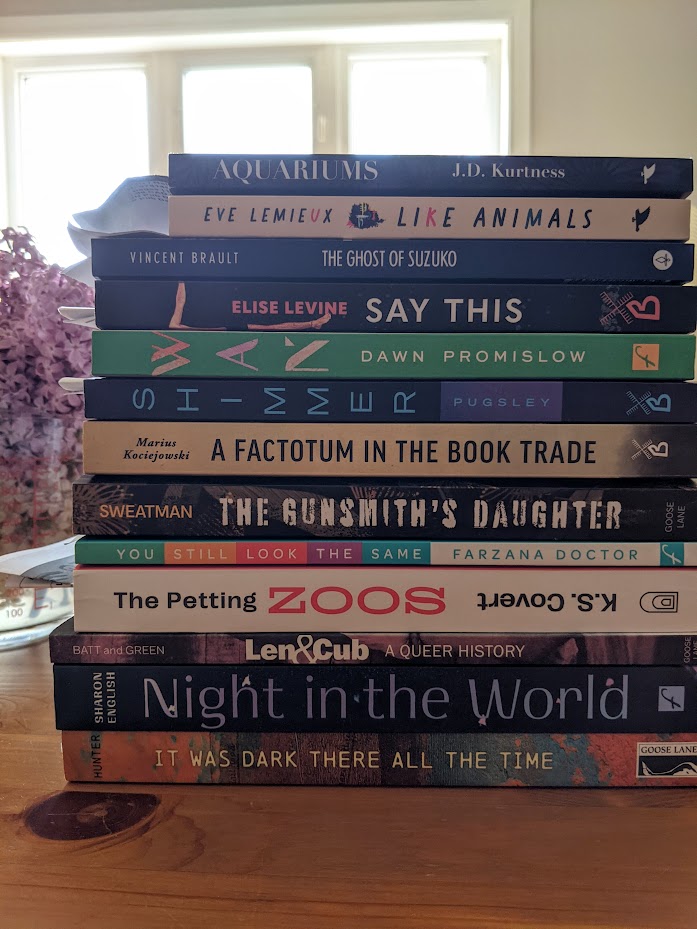
An Avid Reviewer’s Reading Copies: Summer 2022

Some of the pitches I’ve made-to review or discuss these new and forthcoming works-will likely land after I publish this, but I would be pleased to review all of these books; if we’ve worked together previously, let me know your time-frame, and if you’re interested in working together for the first time, please share your rate information and specifics about your revision schedule. This is only the second time I’ve posted a list like this: it worked well, but I’m not considering it a regular feature here yet.)

J. D. Kurtness’ Aquariums from Dundurn Press. This 2019 novel, in a fresh translation by Pablo Strauss (whose work with Christiane Vadnais’ Fauna knocked off my proverbial socks), confronts the climate crisis in the context of marine biology. A trusted reading friend has urged me to push this one to the top of my stack.
ANY EDITOR SEEKING COVERAGE, please reach out.

Also from Dundurn (their pocket-sized Rare Machines imprint), Eve Lemieux’s Like Animals (also translated from the French, this time by Cayman Rock) is a debut novel with a Montreal setting, inspired by “people who haven’t learned to love gently”.
ANY EDITOR SEEKING COVERAGE, please reach out.

Another novel in translation from the French, this time from QC Fiction, Vincent Brault’s The Ghost of Suzuko (translated by Benjamin Hedley), also considers love and loss in an urban setting, this time Tokyo. There’s a mention of taxidermy, which has great symbolic potential (along with a squirm factor, of course).
ANY EDITOR SEEKING COVERAGE, please reach out.

Elise Levine’s Say This, from Biblioasis, has strong appeal because I really enjoyed her debut stories and debut novel, years ago (Driving Men Mad and Requests & Dedications). I’m curious to see how her style and voice have developed since then. Lisa Moore blurbs this volume, two novellas, as “immersive, hyper-vivid and true.”
ANY EDITOR SEEKING COVERAGE, please reach out.
Updated September 1/22: Review space secured

And speaking of shorter forms, Alex Pugsley’s Shimmer is out now from Biblioasis. I’m interested to see how much of his previous book was Aubrey and how much was the author (I reviewed Aubrey McKee for PRISM international a couple of years ago.) It’s a challenge that I particularly enjoy, capturing the flavour and intent of a collection of short stories.
ANY EDITOR SEEKING COVERAGE, please reach out.

Dawn Promislow’s Wan is published by Freehand Books and blurbed by Kathryn Kuitenbrouwer, which immediately piques my interest. “A masterpiece…beautiful, painterly, sublime, and sonically exquisite.” That’s high praise. I’ve read few South African writers, so I am keen to explore Promislow’s writing in that context.
ANY EDITOR SEEKING COVERAGE, please reach out.

Bookish memoirs: I love the idea of them. Marius Kociejowski’s A Factotum in the Book Trade, from Biblioasis, is no exception. This is one that I’ve pitched and, if it doesn’t land, I’m determined to try again and find a match. I’ve read widely in this sector and excited to see how this particular memoir fits into the puzzle of antiquarian bookselling narratives.
ANY EDITOR SEEKING COVERAGE, please reach out.

From Goose Lane, Margaret Sweatman’s sixth book, The Gunsmith’s Daughter, is a coming-of-age story set in 1970s Manitoba. Based on Mr. Jones, I’m anticipating carefully selected historical details in combination with strong storytelling and emotional heft.
ANY EDITOR SEEKING COVERAGE, please reach out.

Because I have followed her career closely, from earliest days, I was immediately interested to hear that Farzana Doctor has published a book of poems, You Still Look the Same, with Freehand Books. Viewed in the broader context of her writing, I’m eager to explore the way that familiar themes and preoccupations surface in a different form; I’m not equipped to analyze or contemplate this work as a volume of verse. That’s for the poets!
ANY EDITOR SEEKING COVERAGE, please reach out.

Phew, you can hear the recoil of many of a reviewer in response to the summary of K.S. Covert’s debut novel from Dundurn, The Petting Zoo: all the talk of vaccines and masks, gloves and isolation. But in the context of post-apocalyptic CanLit and post-pandemic lit, there’s much to discuss.
ANY EDITOR SEEKING COVERAGE, please reach out.

Len & Cub: A Queer History by Meredith J. Batt and Dusty Green, from Goose Lane, immediately appeals. It’s partly because of the abundance of visual material: there are so many expressive and evocative photographs in this volume. It’s also because the New Brunswick setting caught my eye; as much as I’ve tried to increase the amount of Atlantic Canadian reading in my stacks, New Brunswick’s stories remain in the minority, and here is an historical volume to address that gap.
ANY EDITOR SEEKING COVERAGE, please reach out.

Everything about Sharon English’s novel Night in the World, from Freehand, intrigues me. I really loved Uncomfortably Numb back in 2002: authentic and heartfelt, with a particular way of bridging the specific and universal that spoke to me. Just leafing through this volume, I want to start reading right away, as a reader. But my experience with this setting and these themes makes it irresistible as a reviewer.
ANY EDITOR SEEKING COVERAGE, please reach out.
Updated September 1/22: Review space secured

Another which excites me tremendously, too, is Andrew Hunter’s It Was Dark There All the Time: Sophia Burthen and the Legacy of Slavery in Canada, from Goose Lane, because last year I read a few dozen books about the legacy of slavery in the U.S. and Canada, none of which took quite the same approach as this volume. The cover blurb from Lawrence Hill increases my interest too: “Thoroughly researched, self-reflexive, soulful.”
ANY EDITOR SEEKING COVERAGE, please reach out.
Updated September 1/22: Review space secured